Costing a Private Label Lipstick Run: What Moves the Unit Price
Two lipstick quotations for the same shade can differ by more than the shade itself: the quantity each one assumes, whether the base came from a library or a laboratory, how many components make up the pack, and how much of the fill is lost. Those four variables explain most of the gap, and three of them are within the buyer's control before the first sample is poured. A 5,000-unit run needs about 25,000 components and 19.4 kilograms of mass once filling loss is counted.

Key takeaways
- Order quantity appears on every quotation, so quote both a 500-unit and a 5,000-unit version before comparing.
- A library base and a new development are different products commercially, even when the bullet feels similar.
- Component count drives cost quietly: bullet, sleeve, base, cap and label are five items to source and stock.
- Filling loss and sample rounds are small percentages of a run and large percentages of a small one.
Variable one: how much of the cost is fixed
Part of the cost of a lipstick run does not scale with quantity at all: the shade reference, the sample round, the base selection and the batch record each happen once. The rest scales directly: pigment, waxes, oils, the bullet sleeve, the case and the label multiply with every unit.
That split explains why a 500-unit quote can look expensive per unit and still be the cheaper decision for a first run. The fixed part is spread over fewer units, but the cash at risk is ten times smaller than at the top of the band.
Variable two: where the base comes from
A formula from a published library of more than 10,000 mature formulas starts with a base whose behaviour is already known. Adjusting it is work, but it is short work: texture, fragrance and skin feel are the fields that move. A new development starts from the wax and oil ratio instead, and the published route for that is three to six months with research and testing folded into production as a single block.
Commercially, the difference is time rather than a line on the invoice. A base that needs laboratory research ties up a launch window, and the window is usually worth more than the marginal unit cost of a library formula.
Variable three: components multiply quietly
A lipstick is a small piece of assembly. The bullet sits in a sleeve, the sleeve sits in a base, a cap closes it and a label identifies it — five items before the packaging carton, and each one carries its own minimum, its own lead time and its own supplier.
Count them against the order quantity before approving a cost. A custom case adds a mould; a stock case does not. A printed label adds a print run; a direct-printed base does not. Those choices move the unit price more than the cosmetic mass does.
| Item | Published figure | Where it lands in the costing |
|---|---|---|
| Order minimum | 1,000–5,000 units per product | Sets the multiple applied to every variable cost |
| Start-up minimum | 500 units | Lowest-cost route to a real production sample |
| Formula library | 10,000+ mature formulas | Removes research time from the base |
| New development | 3–6 months | Adds a research and testing block before filling |
Variable four: filling loss and sample rounds
Mass is ordered before anything is poured, and a slice of it never ends up in a bullet. A 5,000-unit run at 3.8 g each needs 5,000 × 3.8 = 19,000 g, so 19 kg of bulk; allow 2% for filling loss and the material order becomes 19,000 × 1.02 = 19,380 g, roughly 19.4 kg. The figure on the purchase order is that mass, not the unit count.
Sample rounds behave the same way at a different scale. A shade round that uses about 100 poured bullets consumes 100 ÷ 5,000 = 2% of a 5,000-unit order, and 100 ÷ 500 = 20% of a 500-unit order. On a small run, an extra shade round is a real cost; on a large one it is a rounding error.
Worked example: components against order size
Take the five components named above and a 5,000-unit order. Sleeves, bases, caps and labels each come to 5,000 pieces, so the assembly count is 5 × 5,000 = 25,000 items to receive, inspect and store before a single carton ships. At the 500-unit start-up quantity the same product needs 5 × 500 = 2,500 items.
Now express the order sizes as multiples of the published start-up minimum. The 500-unit trial is 500 ÷ 500 = 1 multiple; a 2,500-unit mid-band run is 2,500 ÷ 500 = 5 multiples; the top of the band, 5,000 units, is 5,000 ÷ 500 = 10 multiples. Both the component count and the mass scale with that multiple, which is why the quantity belongs in the first email rather than in the last negotiation.
Component lead times deserve the same treatment as the cosmetic mass. A stock case can be called off in weeks; a printed carton or a custom outer shell runs on its own schedule and its own minimum, and it is the item most likely to arrive after the bulk is ready. Order the pack first, then the pigment.
Reading the order-size chart
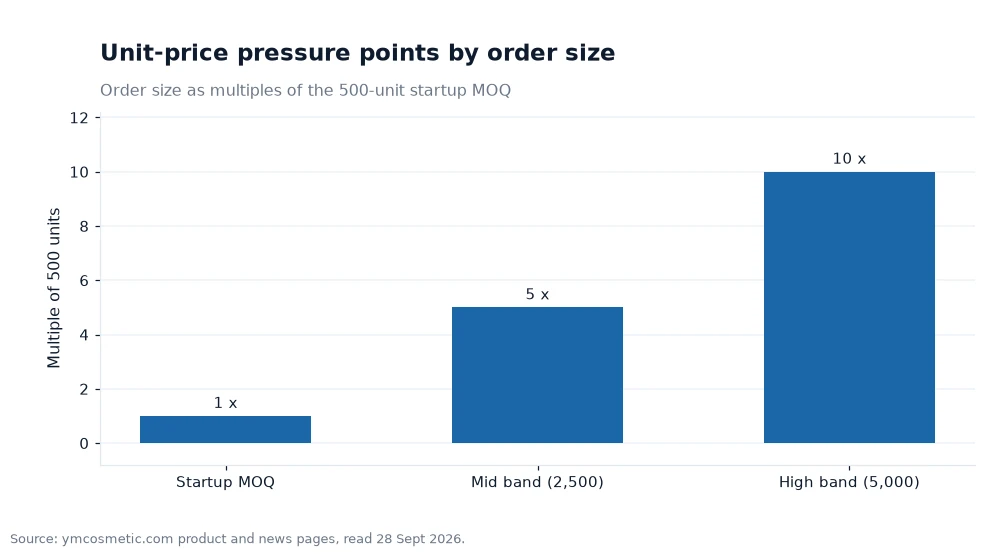
Two things change along those bars. Variable cost per unit barely moves, because materials scale with the multiple. Fixed work per unit falls steeply, because the sample round, the shade reference and the batch record are paid once. The practical reading: negotiate on the fixed lines, accept the variable ones, and choose the multiple that matches your market test rather than the one that flatters the unit price.
Frequently asked questions
Why is the 500-unit price per unit so much higher?
Because the one-off work — reference shade, sample round, base selection, batch record — is divided by ten times fewer units than on a 5,000-unit run. The materials themselves cost roughly the same per unit at either size.
Does a custom case always raise the unit price?
It adds a mould and its own minimum order, which is a fixed cost rather than a per-unit one. That suits larger runs and penalises small ones, so a stock case is often the right first choice and a custom case the second run's upgrade.
How should sample rounds be budgeted?
As a percentage of the order. Around 100 poured bullets is about 2% of a 5,000-unit run and about 20% of a 500-unit run, so the smaller the first order, the more carefully the shade should be specified before pouring begins.
Building a comparable quotation
Ask every supplier for the same four numbers: order quantity assumed, base source, component list and filling loss. A quote that states all four can be compared line by line; one that states only a unit price cannot. If you are still choosing between the private label lipstick manufacturers on your list, ask each one the same questions in the same order. Yunmei's OEM/ODM manufacturing service pages describe how a project moves from formula selection to a packed carton, and the supplier comparison article applies the same costing questions to a broader shortlist.
Ymcosmetic.com, the manufacturer's own website, published the order minimums, the formula library size and the development routes quoted here; my read date is 28 Sept 2026. The 3.8 g bullet, the 2% filling loss, the five-component count and the 100-bullet sample round are my own assumptions, shown so you can replace them.[1].