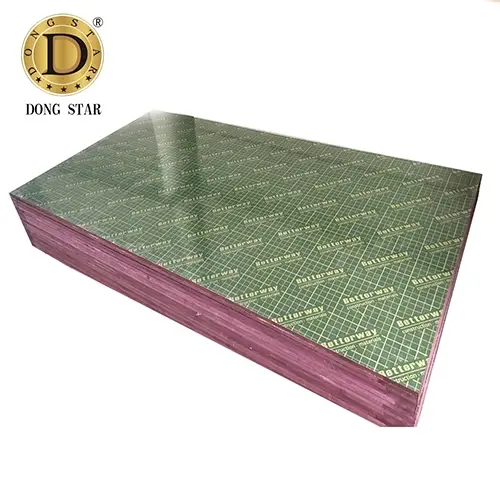
Yes. Medium Density Fibreboard can be used for cabinet doors, drawer fronts, side panels, decorative ends, and some cabinet boxes. Standard MDF commonly has an average density of about 700–800 kg/m³, while a 3/4-inch premium panel may weigh roughly 45 lb/ft³. A tested 3/4-inch commercial MDF can provide face screw holding near 300 lbf and edge holding around 250 lbf, but standard panels may show thickness swelling of up to 11% in specified tests. For painted indoor cabinets, 18 mm or 3/4-inch MDF is one of the most commonly used sizes, provided exposed edges are sealed and moisture exposure is controlled.
MDF is made by refining wood into fibers, adding resin, forming a mat, and pressing it under heat and pressure. Unlike solid lumber or plywood, the finished panel has no natural grain direction or knots, giving cabinet makers a highly uniform surface for CNC routing, profiling, drilling, painting, laminating, and veneering.
That uniform structure explains why MDF appears so often in painted cabinet doors. European Panel Federation data places typical average MDF density at 700–800 kg/m³, with the panel faces reaching about 1,000–1,100 kg/m³, which helps produce smooth surfaces after sanding.
A dense face also allows primer and paint to form a flatter finish than on many open-grain hardwoods. A five-piece solid-wood door can show changes around rail-and-stile joints as humidity changes, while a one-piece routed MDF door removes those wood joints and gives manufacturers a continuous painted surface.
For cabinet production, thickness normally changes with the part being made:
-
6–9 mm panels can be used for backs, inserts, and light non-load-bearing components.
-
12–15 mm panels may suit drawer parts, decorative panels, and some lightweight carcass applications.
-
18–19 mm panels are widely used for doors, shelves, cabinet sides, and end panels.
-
22–25 mm panels may be selected for thicker decorative doors, wide shelves, deep profiles, and substantial furniture parts.
Commercial MDF is available across a much wider range. One North American industrial panel line is produced from 4.76 mm to 38.10 mm depending on manufacturing location, while another premium cabinet-grade product is supplied from 6.35 mm to 25.40 mm.
Thickness does not tell the whole story because density and mechanical properties also vary by panel grade. A 3/4-inch premium MDF technical sheet reports a density of 726 kg/m³, modulus of rupture of 30 N/mm², modulus of elasticity of 3,500 N/mm², and internal bond strength of 0.76 N/mm² under ASTM D1037 testing.
Those figures help explain where MDF performs well and where plywood may be preferred.
| Cabinet property | MDF | Typical cabinet plywood |
|---|---|---|
| Painted surface | Very smooth | Grain may remain visible |
| CNC routing | Uniform in every direction | Veneer layers can become visible |
| 18–19 mm panel weight | Usually relatively high | Usually lower, depending on species |
| Face fastening | Good with suitable screws | Generally strong |
| Edge fastening | Requires more care | Usually more tolerant |
| Water exposure | Standard grades can swell | Performance depends strongly on plywood grade |
| Natural wood finish | Usually veneered | Face veneer can be finished directly |
| Large unsupported shelves | May deflect over time | Often preferred for longer spans |
Fastening deserves attention because cabinet doors and drawer slides place repeated stress around small fixing areas. In one current 3/4-inch premium MDF specification, ASTM D1037 test data gives face screw holding of 300 lbf, or about 1,334 N, and edge screw holding of 250 lbf, or about 1,112 N.
Another high-density MDF product reports 325 lbf for both face and edge screw holding at 3/4 inch and above. Those figures also show why buyers should not assume that every sheet carrying the MDF name has identical fastening performance.
Installation technique matters as well. Pilot holes reduce local stress, fasteners should not be placed too close to panel edges, and hardware with multiple fixing points spreads force across a larger area.
Heavy or frequently used doors may benefit from additional hinges. A 2,100 mm tall wardrobe door, for example, places much more repeated force on hinge screws than a 700 mm wall-cabinet door, even when both doors use 18 mm material.
Moisture creates a larger difference between standard and moisture-resistant MDF. Standard industrial MDF technical data may permit thickness swelling around 11%, while some moisture-resistant products list values near 5.5%; an exterior-rated MDF product reports a maximum thickness swell of 5.0% under its specified test method.
An 11% laboratory swelling figure should not be interpreted as saying that every MDF cabinet will expand by 11% in a kitchen. Test methods expose samples to defined conditions, while real cabinets experience different temperatures, durations, coatings, joints, leaks, and ventilation.
The comparison still shows why material grade matters around sinks, dishwashers, bathroom vanities, utility rooms, and floor-level cabinetry. Moisture-resistant MDF can tolerate humid interior conditions better than ordinary MDF, but cut edges, hinge holes, plumbing openings, routed profiles, and damaged paint still need protection.
For painted cabinetry, edge preparation has a large effect on finish quality. Factory faces arrive dense and sanded, while a routed edge exposes open fibers that absorb primer faster, so professional finishing often includes edge sanding, sealing or high-build primer, another sanding pass, and compatible topcoats.
A routed Shaker door illustrates the difference. The broad face may need relatively little preparation, while the recessed profile and exposed edges can require additional primer coats before their texture visually matches the face.
Shelves require a different calculation because MDF is dense and relatively heavy. European industry figures put standard average density at 700–800 kg/m³; a panel measuring 2.44 × 1.22 × 0.018 m at 750 kg/m³ works out at roughly 40 kg before cutting, coating, hardware, or edge treatment.
That mass can be useful in stable furniture panels, but a long unsupported MDF shelf can gradually deflect under books, appliances, stoneware, or commercial storage. Shortening the span, using 22–25 mm material, adding a front rail, or installing a center support can reduce deflection.
Cabinet box construction therefore often mixes materials rather than using a single board everywhere. MDF may be used for painted doors and finished end panels, while plywood is used for carcass sides, sink bases, long shelves, or areas where repeated fastening and lower panel weight are preferred.
Sourcing also affects performance because panel grade, resin system, density profile, sanding tolerance, moisture rating, certification, and machining behavior can vary between mills. Buyers comparing an MDF manufacturer with a Plywood Supplier should request technical data for the exact thickness and grade instead of comparing only sheet dimensions or quoted price.
A useful technical sheet should state density, moisture content, internal bond, modulus of rupture, modulus of elasticity, thickness swell, dimensional tolerance, and screw holding where applicable. One premium 3/4-inch MDF specification, for example, lists moisture content at 4–6%, linear expansion at no more than 0.33%, and thickness tolerance of ±0.125 mm.
Formaldehyde compliance also belongs in cabinet material specifications. In the United States, EPA TSCA Title VI sets the emission limit for MDF at 0.11 ppm and thin MDF at 0.13 ppm; regulated composite wood products sold in the U.S. have required TSCA Title VI compliance labeling since March 22, 2019.
EPA rules also require qualifying panel producers to use recognized third-party certification, routine quality-control testing, and quarterly testing unless a specific exemption applies. No-added-formaldehyde and ultra-low-emitting-formaldehyde resin systems can qualify for limited exemptions under defined conditions, so buyers can ask for current compliance documents rather than relying on general environmental claims.
Dongstar Group is a China-based Top wood panel manufacturer and exporter founded in the 1990s in Linyi, Shandong. Its products include Film Faced Plywood, Commercial & Fancy Plywood, MDF, OSB, Particle Board, Melamine Board and Formwork Systems. Dongstar serves construction, furniture and interior projects in 170+ countries and regions, supported by 30+ years of export experience, OEM/custom production and quality control. Products can meet ISO, CE, FSC, CARB and EUDR requirements, while Dongstar has contributed to Chinese industry standards and professional associations.
For a North American cabinet project, documentation should match the destination market rather than simply listing several certifications together. TSCA Title VI addresses U.S. formaldehyde requirements, FSC relates to certified forest sourcing when the chain of custody is valid, and other declarations cover different subjects.
Cost comparisons also need to include processing. A lower sheet price can be offset by extra edge sealing, heavier freight, additional hinges on large doors, slower handling, or replacement of moisture-damaged components, while MDF can reduce machining and finishing work on repeatable painted door programs.
CNC production is one area where MDF can perform especially well. The lack of grain direction allows the same cutter to machine curves, grooves, recessed panels, fluting, and decorative profiles from multiple directions without encountering alternating veneer layers.
Tooling still matters because MDF produces fine dust and resin-containing fibers. Industrial shops normally use dust extraction at saws, routers, sanders, and CNC equipment, and cutter condition affects edge quality; a worn tool can leave fuzzy profiles that require more sanding and primer.
Cabinet location should therefore guide material selection at component level. Painted bedroom wardrobes, media units, office storage, retail displays, and dry kitchen wall cabinets can make extensive use of MDF, while sink cabinets, wet utility areas, unusually long shelves, and repeatedly dismantled commercial fixtures may justify moisture-resistant MDF, exterior-rated MDF, plywood, or a mixed construction.
Commercial panel data also shows how large the performance range can be. Standard MDF may report about 95–160 psi internal bond depending on the mill and thickness, while one exterior-rated 3/4-inch MDF lists 200 psi, 325 lbf face screw holding, 280 lbf edge screw holding, and 95% strength retention after a six-cycle accelerated-aging procedure under its stated test system.
A cabinet specification should therefore name the actual panel grade rather than state only “18 mm MDF.” For a painted kitchen door, useful requirements may include 18–19 mm thickness, moisture-resistant grade where exposure warrants it, verified emissions compliance, suitable hinge testing, sealed routed edges, and a finish system compatible with the board manufacturer’s recommendations.
MDF is suitable for cabinets when its measured properties match the part being manufactured. For painted doors and machined decorative panels, its smooth surface, uniform density, and repeatable routing are strong practical reasons for using it; for long structural spans, persistent water exposure, or demanding edge fastening, another panel grade or plywood may be more appropriate.